Geography of the Philippines

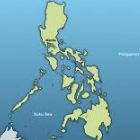
Map of the Philippines

Click to enlarge in a new window
Click on the map to enlarge in a new window

Where on Earth are the Philippines?

A democratic republic located in the Western Pacific Ocean, the Republic of the Philippines is made up of the Philippine Islands and is the island group at the northernmost part of the Malay Archipelago. The Philippines is situated about 1,210 km (about 750 mi) east of the coast of Vietnam and is separated in the north from Taiwan by the Bashi Channel. Bounded on the east by the Philippine Sea (and Pacific Ocean), on the south by the Celebes Sea, and on the west by the South China Sea, the archipelagic state comprises about 7,107 islands, but only 2,000 are inhabited. It lies between 116° 40' and 126° 34' E. longitude, and 4° 40' and 21° 10' N. latitude. Resulting from this situation are great variations in climate, geography and vegetation.

Geology

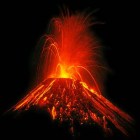
The Philippine Island group is of volcanic origin and generally mountainous. Running parallel to the coasts, as well as bordering them in many places, the mountain ranges extend north to south. Lying on the northwestern fringes of the Pacific Ring of Fire, the Philippines experiences frequent seismic and volcanic activities. Some 20 earthquakes are registered daily in the Philippines, though most are too weak to be felt. The last great earthquake was the 1990 Luzon earthquake. There are 18 active volcanoes on the islands. The official definition of an active volcano is that it must have at least one recorded eruption since 1521. The most dangerous volcanoes are under permanent supervision. Below is the observatory of mount Hibok-Hibok on Camiguin island. The Philippine Institute of Volcanology & Seismology (PHILVOLCS) station monitors the volcano's actiity. While we shot the photos, there were two small earthquakes recorded in the peak seismometer.
Mount Hibok-Hibok PHILVOLCS observatory Seismometers Data processing
The 5 most recently active volcanoes are: Pinatubo (1450m, Pampanga/Zambales), Mayon (2462m, Albay), Taal (311m, Batangas), Bulusan (1559m, Sorsogon) and Hibok-Hibok (1332m, Camiguin).

Several islands are not of volcanic origin but of sediments and coral blocks. Among them are the 3 large islands of Mindoro, Panay and Palawan.
The larger islands, Luzon and Mindanao, are characterized by high mountains with alluvial plains and narrow fertile valleys. Unlike the larger islands with their relatively diverse topography, the smaller islands are mountainous with surrounding flat lowlands. Mount Apo, the Philippines' highest point, reaches 9692 ft (2954 m) and is found in the southernmost ranges on Mindanao, the second largest Philippine island. The longest river is the Cagayan River of northern Luzon. The nearly circular Manila Bay, is connected to the Laguna de Bay by means of the Pasig River. Subic Bay, the Davao Gulf and the Moro Gulf are some of the important bays. Transversing the San Juanico Strait is the San Juanico Bridge, that connects the islands of Samar and Leyte


Flag of the Philippines

Flag of the Philippines The Flag of Philippines is beautiful and also symbolic. It contains two horizontal bands, which are of same size. The upper band is blue and the lower one is red. In the hoist side there is a triangle, colored in white. It is an equilateral triangle. The triangle bears a yellow sun, which has eight rays. The sun is featured in the center of the triangle. In the three corners of the triangle, there are three stars. These stars are symbolic of the three geographical partitions of Philippines. Luzon, Visayas and Mindanao. The eight rays of the sun are representative of the first eight provinces that sought independence from Spain. The blue color signifies peace and justice. On the other hand the red color signifies the courage. In wartime the flag is flown upside down with the red band at the top.

The Visayas

The Western Visayas

Western Visayas

Western Visayas, one of the regions of the Philippines, is designated as Region VI. It consists of seven provinces, namely, Aklan, Antique, Negros Occidental, Capiz, Guimaras, Iloilo and Palawan and 17 cities making it the region with the most number of cities. Iloilo City is the regional center of the region.

The Philippine Province of Aklan occupies the northwestern coastal plain of the island of Panay, in Region VI, Western Visayas. Its 1,853 sq. km. supports a population of 441,000 in seventeen municipalities, of which Kalibo is the capital. After strenuous and sustained political efforts, Aklan was separated from Capiz by act of the national legislature in April 1956. Agriculture is a prominent part of the economy, principal products being rice, maize, coconuts, and cut flowers. Ocean- fishing is also important, as is tourism, Boracay, a white-sand island just offshore, being a world-class resort. Inland fishing and aquaculture yield several export products. This actually seems to explain every element in the shield. Cottage weaving is widespread, and rattan furniture is manufactured for export.

The province of Antique, on the western side of Panay, is separated from the other provinces by a long range of mountains. One of these, Mt. Madia-as, is the highest mountain on the island, a dormant volcano adorned with several lakes and more than a dozen waterfalls. The population is largely Malay, immigrants from Borneo centuries before the Spanish arrived. Their language, Kiniray-a, is Indo-Malayan. Several Visaya dialects are also spoken. The area was made a separate province by the Spanish government in 1790. Its name seems to be a Spanish adaptation of a local word. The province's area is 2,522 sq.km., its population 456,000, no cities, eighteen towns, of which San José de Buenavista is the capital. Agriculture is important; sugar and coconuts lead, with coconut oil and coconut wine both being significant. Ocean fishing is also important; one website speaks of "the tuna highway along the coast." Seaweed is harvested. Marble and gemstones are mined. Other valuable mineral deposits are known but undisturbed. Like Capiz, it seems to have enormous potential for tourism, its many miles of sandy beaches being sparsely settled. There are also hot springs in the mountains.

The people of Negros Occidental speak mostly Ilonggo, a Visaya dialect; Cebuano, another Visaya dialect, is a distant second. Most also speak English. In the second half of the nineteenth century sugar cane cultivation grew enormously, drawing many settlers from other islands. Negros Occidental was made a separate province in 1890. In spite of three periods of warfare, sugar remained dominant long into the twentieth century, as the province came to produce most of the country's total sugar production. In the late 1970s the world price of sugar fell sharply, and continued into the early 1980s, and in 1983 the province suffered a serious drought, and, in 1984, two typhoons. An attempt in 1986 to separate the northern part as the province of Negros del Norte was defeated. Meanwhile, starting in 1985, the province received considerable help from the national government and foreign donors to recover economically, which included economic diversification. Today the province has substantial production of coffee, cacao, black pepper, fruits, and grains. It also has a large copper mine. Gold, silver, molybdenum, iron, gypsum, coal, and other minerals are mined. Light industry is growing. Should one wish to visit and disburse, there are excellent opportunities for aquatic recreations, including underwater photography. Mount Kanlaon, the highest peak on the island, is a bird sanctuary, home to a hundred species known nowhere else in the world. The sugar industry led to the building of steam railroads, now nicknamed "iron dinosaurs." Some are still roar and race and breathe fire; others, abandoned, moulder away. The population of Negros Occidental is 2,556,000 in six cities and twenty-six towns. In addition to the capital city of Bacolod, Negros Occidental has five cities, Bago, Cadiz, La Carlota, San Carlos, and Silay, to which the provincial government's website adds Kabankalan, Sagay, Talisay, and Victorias.

back to the top

The Central Visayas

Central Visayas

Central Visayas, one of the regions of the Philippines, is designated as Region VII. It is part of the Visayas. It consists of four provinces, namely, Bohol, Cebu, Negros Oriental, and Siquijor. The region demarcates the territory occupied by the native speakers of Cebuano. The regional capital is Cebu City.

The total land area of the region is 14852 km².

Negros Oriental, occupying the eastern part of the island of Negros. A mountain range down the middle of the island has determined that the eastern coast has less in common with the western coast than with neighboring islands. The province has a population of 1,124,000 by the 2000 census on 5402 sq.km. in twenty-two towns and three cities, Dumaguete (the capital), Canlaon, and Bais. The population has long been a mix of Negritos, Malays, and Chinese. From about the middle of the nineteenth century Visayas have immigrated in numbers from Cebu. The people speak Cebuano (Visaya), Tagalog, Ilonggo, English, and Spanish. The economy depends largely on agriculture in several forms, fishing and aquaculture in several forms, and tourism.

The capital city of Dumaguete has a relatively simple shield. Its blue and white wavy base symbolizes the city's coastal location. The towers were built to guard against pirate raids. The city makes furniture, housewares, and jewelry. It is home to three important universities. The city carries environmentalism to heights seldom seen elsewhere; its municipal dump is not merely a public park but home to a number of species of rare animals and birds.

back to the top

The Eastern Visayas

Eastern Visayas

Eastern Visayas is one of the two regions of the Philippines having no land border with another region, MIMARO being the other, and is designated as Region VIII. It consists of six provinces, namely, Biliran, Eastern Samar, Leyte, Northern Samar, Samar (Western Samar) and Southern Leyte. These provinces occupy the easternmost islands of Visayas: Leyte, Samar and Biliran. The regional center is Tacloban City, one of two cities of Leyte. Calbayog City is the lone city in Samar, one of the oldest in the country

Region VIII is inhabited by the Waray-Warays, the country's fourth largest cultural linguistic group. But Cebuanos, from the nearby island of Cebu live in Ormoc City, Western Leyte and parts of the southwest of Leyte.

The eastern portion of the region is frequently visited by storms from the Pacific Ocean. The region receives heavy rainfall throughout the year with no pronounced dry season.

Eastern Visayas is primarily an agricultural region with rice, corn, coconut, sugarcane and banana as major crops. Its total land area is 21,431.7 sq. kms. 52% of its total land area are classified as forestland and 48% as alienable and disposable land.

The region's sea and inland waters are rich sources of salt and fresh water fish and other marine products. It is one of the fish exporting regions of the country.

There are substantial forest reserves in the interiors of the islands. Its mineral deposits include chromite, nickel, clay, coal, limestone, pyrite and sand and gravel.

It has abundant geothermal energy and water resources to support the needs of medium and heavy industries.

Primary sources of revenue are manufacturing, wholesale and retail trade and services. Mining, farming, fishing and tourism contribute significantly to the economy Manufacturing firms include mining companies, fertilizer plants, sugar central, rice and corn mills and other food processing plants. Cebu is the hub of investment, trade and development in the region.

Other industries include mining, rice, corn and sugar milling, coconut oil extraction, alcohol distilling, beverage manufacture and forest products. Home industries include hat and basket weaving, metal craft, needlecraft, pottery, ceramics, woodcraft, shell craft and bamboo craft.